Supply chain attacks in the AI era: the state of open source in 2026
Modern software runs on third-party dependencies. Every time a developer builds or ships an application, their package manager automatically resolves dozens — sometimes hundreds — of dependencies from public registries; and that step is increasingly run by an AI agent acting on their behalf. There are millions of packages in those registries. And over the past year, several of the most popular have been hijacked to ship malicious code.
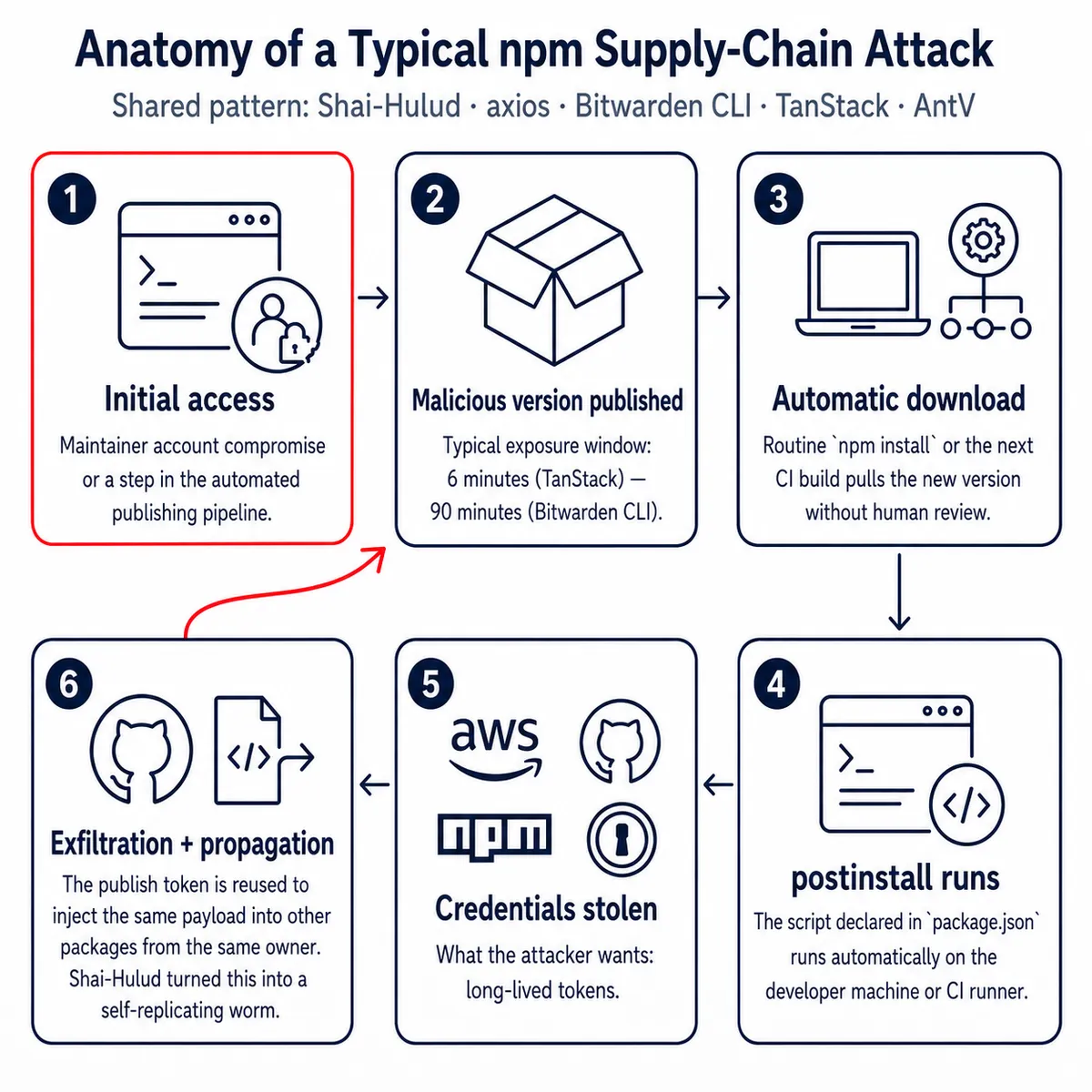
The track record from the past year speaks for itself. In September 2025, npm saw its first self-replicating worm: code that, once installed on a developer’s machine, harvested their credentials and republished itself into other packages owned by the same person — infecting hundreds within days. In March, axios — a library used by thousands of companies, with over 100 million weekly downloads — shipped two malicious versions inside a 39-minute window. In April, Bitwarden’s command-line tool was under attacker control for ninety minutes, and the first thing the malware did once it landed on a machine was scan for installed AI coding assistants. Then May: 42 packages in the @tanstack/* organization compromised in a six-minute window, eight days later hundreds more under @antv/* in a twenty-two-minute one, and just as I was writing this post, Microsoft caught 14 typosquats of @opensearch-project no longer chasing developer credentials — going straight for AWS and CI/CD pipeline secrets.
If you ship software in 2026, the repositories you depend on are under coordinated attack. Malicious packages have always existed — what’s new is the speed, the scale, and AI breaking into both sides of the game. On the attacker side, AI is being used to invent plausible-sounding package names, to re-obfuscate the malicious code between victims, and to target the developer’s own AI coding assistants. On the victim side, those same assistants are running npm install for us with less and less human review. A poisoned agent writes poisoned code for months.
What follows is a map of what’s happening, who’s getting hit, and how AI is rewriting the playbook — with a concrete defensive baseline at the end, the same one I just landed on this site, for developers who want to close the gap. Almost every citation links to a primary source: vendor postmortems, security-firm research, CISA advisories. None of this is speculation.
The wave is not just npm
The headlines are mostly about npm because it’s the registry with the biggest blast radius — a single popular package can have hundreds of millions of weekly downloads. But the same playbook has been running on every major public registry.
In its State of the Software Supply Chain 2026, Sonatype counted over 454,000 new malicious packages in 2025 alone — up 75% year over year. From the same report: developers accept 39% of AI-suggested code without review. Those two numbers, read together, explain why today’s attacks feel different from the ones five years ago.
npm — the headline incidents
Shai-Hulud (September 2025). The first self-replicating worm in npm history — and the event that defined the rest of the year. A computer worm is code that copies itself from one victim to another; in this case, once a developer installed the compromised version of the @ctrl/tinycolor package, the code scanned their machine for credentials — Amazon Web Services keys, GitHub access, the npm publish token that lets the package owner ship new versions — and used that last token to infect up to twenty more packages owned by the same person. CISA issued an alert on September 23. By the end of the month the infected-package count had climbed from around 180 to over 500. A second wave hit two months later, this time with a destructive fallback: if the code couldn’t exfiltrate credentials cleanly, it wiped the user’s home directory. StepSecurity has the most detailed technical analysis.
Axios (March 2026). The thing to underline: it wasn’t a fake package with a similar name. It was the real axios package, one of the most-used libraries in the Node.js ecosystem (over 100 million weekly downloads, 174,000 dependent projects). On March 31, someone with access to the maintainer’s account published two malicious versions 39 minutes apart. Any project configured to auto-update to the latest minor version of axios — npm’s default behavior — pulled the malware on its next install. The code downloaded and ran a remote-access program on the machine, giving the attacker control of every unsuspecting developer’s box. Socket’s postmortem unpacks it well. Root cause: an old maintainer credential still active alongside the new secure authentication setup. A single forgotten setting.
Bitwarden CLI (April 2026). Bitwarden is a password manager; its command-line tool ships via npm. It was compromised for about ninety minutes on April 22. The interesting part wasn’t how the attackers got in — initial access came through a piece of Bitwarden’s own automated packaging pipeline, not the maintainer’s account — but what the code did once installed. Palo Alto’s analysis describes the part that keeps coming back to me: the first thing it looked for on the developer’s machine was installations of Claude Code and Cursor — two of the most popular AI coding assistants — and tried to modify their configuration to inject persistent instructions. End-user Bitwarden vaults were not touched (official statement). But what the attack targeted tells you exactly where attackers think the next big leverage point lives.
TanStack (May 11, 2026). TanStack is a popular collection of libraries in the React world. The official postmortem walks through three chained vulnerabilities in the automated system the team uses to publish new versions: someone leveraged that chain to extract the credential the pipeline uses to publish to npm, and used it to ship 84 malicious versions across 42 packages. Detection took 20–26 minutes; all of them were deprecated within an hour and 43 minutes. Fast response. Still very bad. OpenAI published its own postmortem confirming two corporate devices were impacted, and responded by rolling out a specific defense (minimumReleaseAge, covered later in this post) across all of its internal pipelines. It’s the first documented adoption at an organization of that size.
AntV (May 19, 2026). Eight days after TanStack, another massive wave. The account of a maintainer of data-visualization packages published 637 malicious versions across 317 packages in a 22-minute window, including some with real traffic (size-sensor, echarts-for-react, timeago.js — several million weekly downloads each). Microsoft Security attributed the attack to TeamPCP, the same group behind recent Shai-Hulud variants. The code stole credentials from password managers, cloud access, and infrastructure permissions. But the important thing here is the scale: 637 versions in 22 minutes isn’t published by hand. The attackers automated the supply side. The defenders — review, alert, deprecate — are still human.
vpmdhaj typosquats (May 28, 2026). Microsoft Security disclosed 14 malicious packages published over four hours by a newly-registered account under the alias vpmdhaj. All of them mimicked names from the official opensearch-project org (opensearch-setup, opensearch-security-scanner, elastic-opensearch-helper, among others) — classic typosquatting aimed at developers reaching for legitimate OpenSearch or ElasticSearch tooling. What’s new is the target. The preinstall script downloads the Bun runtime directly from GitHub Releases — a signed, legitimate binary — and uses it to execute a 195 KB credential harvester. That harvester queries AWS’s internal metadata services — EC2 and ECS, the endpoints that expose temporary credentials for instances and containers — enumerates AWS Secrets Manager across 16+ regions, reads HashiCorp Vault tokens, validates npm publish tokens, and captures GitHub Actions runner context. It’s not personal-machine credential theft: it’s targeted CI/CD and cloud infrastructure theft. And unlike the rest of the incidents on this list, Microsoft did not attribute the campaign to Shai-Hulud or TeamPCP — new actor, new target.
PyPI — same playbook, fewer headlines
Microsoft durabletask (May 2026). Yes: an official Microsoft package on the public Python repository. About 417,000 monthly downloads. Two versions published minutes apart shipped a module called roulette.py with two destructive modes: one checked the system’s regional settings and only activated on machines configured for Iranian or Israeli locales; the other was a “Russian roulette” with a 1-in-6 chance of wiping the disk. It’s the first documented case of an official Microsoft package on the Python ecosystem shipping destructive code. The important shift: the damage isn’t limited to credential theft anymore. It includes sabotage.
Lazarus Group (2025). Sonatype blocked 234 malicious packages attributed to the North Korean Lazarus group in the first half of 2025, distributed through a LinkedIn campaign where a supposed recruiter asked crypto developers to “take a look at this code.” This is not a single actor, it’s a state-coordinated operation, sustained over time, and it crosses ecosystems (npm and PyPI at the same time).
Beyond npm and PyPI
The same pattern has replicated across other ecosystems (Ruby, Rust, Java, Docker), with less volume and fewer headlines. The milestone worth naming is from May 2026: Ruby Central — the team that maintains the Ruby package repository — temporarily suspended new account signups after hundreds of malicious packages were uploaded in a short window. They re-enabled signups a few days later, this time behind a WAF (a firewall that filters suspicious web traffic) and tighter limits on account creation. It’s the first time a major repository has temporarily closed its front door to slow an active attack. Something that would have been unthinkable two years ago.
The pattern is clear across all of the above: the registry-level attack and the publishing-pipeline-level attack are converging. Developer credentials get stolen, pipelines get leveraged, the malicious code runs both on personal machines and inside companies’ internal systems — and the loot, ironically, is more credentials to keep expanding.
Where AI is actually accelerating this
I want to be careful here because half of what gets written about “AI in supply chain attacks” is breathless and undersourced. What follows is verified and backed by concrete evidence.
Slopsquatting
Two terms first. Typosquatting is when an attacker registers a package with a name nearly identical to a legitimate one (requets instead of requests, loadsh instead of lodash) hoping someone installs it by mistyping. It’s been around forever.
Slopsquatting is the same thing, but built on a newer observation: AI models invent package names that don’t exist. In an academic study on 576,000 code snippets generated by 16 different models, commercial models invented non-existent packages in roughly 5% of suggestions; open-source models, in 22%. Those names aren’t random — they’re plausible, they sound real, and the models tend to repeat the same invented names across different conversations. Predictable things are exploitable things.
Seth Larson at the Python Software Foundation coined the term slopsquatting in April 2025 to describe the next step: an attacker watches what packages AI models hallucinate, registers those fake names on the real repository, and waits. When a developer (or, increasingly, an AI agent acting on their behalf) pastes the suggestion and runs the install command, the malware arrives on its own. A Lasso Security researcher proved this works back in 2023: he registered a Python package with a name LLMs kept inventing, and it racked up 30,000+ downloads in three months. Alibaba’s own README ended up copy-pasting the install command.
The attacker no longer has to guess what someone will mistype. The model tells them.
When the attack targets the AI assistant itself
The second axis is on the malicious code side. The Bitwarden CLI compromise is one of the cleanest examples: the code specifically went after Claude and Cursor installations and tried to modify their configuration to inject persistent instructions. The thinking is obvious: if you can poison a developer’s AI copilot, every line of code that person writes for the next several months is suspect. The bug isn’t in what the dev typed; it’s in what the model dictated.
The same pattern repeated with the Nx Console VS Code extension hijack in May 2026 — around 2.2 million installations. The malicious code specifically targeted the folder where Claude Code stores its configuration and its Anthropic access keys. Alongside that: 1Password vault data, GitHub access, npm publish tokens, AWS credentials. The extension was active for 11 to 18 minutes. As collateral damage of the same incident, GitHub confirmed unauthorized access to its own internal repositories during the same window — attackers claimed to have exfiltrated around 4,000.
In April 2026, Socket disclosed SANDWORM_MODE — another Shai-Hulud-family worm that does something new. Each time it infects a machine, it uses a locally-running AI model (Ollama, a tool that lets you run models without sending anything to the cloud) to rewrite its own code — rename variables, change structure, add filler — before propagating to the next victim. Every copy looks different. Defenses that look for “this exact piece of code is bad” struggle when the code changes every hop. And the same worm steals access keys for nine AI providers — OpenAI, Anthropic, Google, and others — because in 2026, an AI key on the black market is worth as much as an AWS key.
And in May 2026, Socket exposed the TrapDoor campaign — over 380 malicious versions distributed simultaneously across the Node.js, Python and Rust repositories. The second stage of the attack does something I hadn’t seen before: it drops files called .cursorrules and CLAUDE.md on the computer — the files where developers store the rules and context their AI assistants should use. But those files use invisible characters from the Unicode standard: the developer opens them and only sees their own rules, while the AI assistant reads hostile hidden instructions. The next function the copilot generates may carry a backdoor the machine’s owner never asked for. It’s the natural evolution of slopsquatting: if the first generation poisoned the package name, this one poisons the prompt your agent is reading.
When AI finds the vulnerabilities first
Everything above acts after the vulnerability exists. The axis opening up in parallel — and the more uncomfortable one — is discovery itself.
In April 2026, Anthropic announced Claude Mythos Preview, a model that found thousands of zero-days across the major operating systems and browsers. What’s new is the economics: finding a critical bug in OpenBSD cost about $50, and chaining discovery, exploit, and privilege escalation against a FreeBSD server — without human intervention — came in under $2,000. Anthropic decided not to release it and assembled a $100M defensive coalition to patch critical infrastructure before an unrestrained equivalent lands in attacker hands. I unpacked the full release in Claude Mythos: The Model Too Dangerous to Release.
What matters for this post: supply-chain defense rests on a temporal asymmetry — maintainers take months to find bugs, attackers take months too. When an attacker with two thousand dollars and a week can discover a critical flaw and a working exploit inside a package that thousands of projects depend on, “we’ll trust this version because it’s been published a while” falls short. As CrowdStrike’s CTO put it: “The window between vulnerability discovery and exploitation has collapsed — now minutes with AI.”
That doesn’t invalidate the defensive baseline coming next. It puts a ceiling on it: a seven-day delay protects you from a maintainer hijacked for ninety minutes; it does not protect you from a vulnerability a model discovered yesterday inside a version you’ve been running in production for three months. Two different classes of attack. This post covers the first; the second probably deserves its own writeup once it shows up in the wild.
The defensive baseline
From here the post gets more technical — it dives into specific tool configuration. If you’re not a developer, the important takeaway is that these attacks are preventable with small, well-documented changes. If you have a technical team, send them this link.
For the developers still reading: most of the registry-side fixes — secure authentication, mandatory 2FA, cryptographic signing on every published package — happen on the publisher side and don’t affect what shows up in your node_modules next Tuesday. The install-side baseline is on us. None of what follows is heroic, and most of it is one-line changes. The hard part is doing all of them, not just one. I just shipped this exact stack on this site in PR #131; the snippets below are taken from that diff verbatim.
Why pnpm, not npm
Tool choice matters before configuration. In npm by default, every dependency can run arbitrary code on your machine the moment you finish typing npm install — through the preinstall, install, and postinstall hooks any package can declare in its package.json. Every incident in the previous section — Shai-Hulud, axios, Bitwarden CLI, TanStack — relied exactly on that automatic execution to do its work. A single npm install during any of those attack windows was enough to get infected.
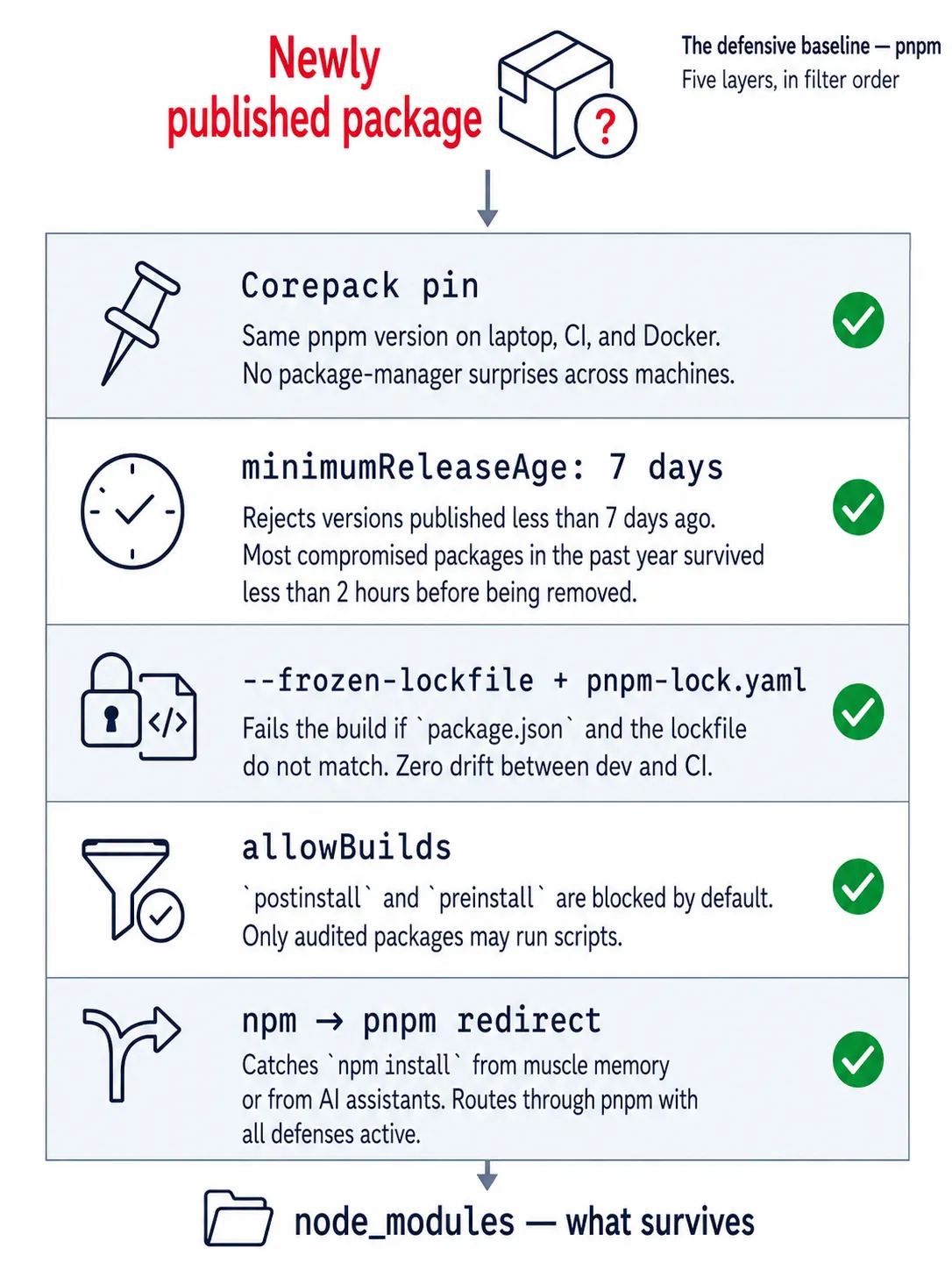
Since pnpm 10, those scripts are blocked by default. pnpm assumes no dependency has the right to run code on your machine, and you explicitly allow-list the ones that do — that’s the allowBuilds subsection below. On top of that, minimumReleaseAge (also below) refuses newly-published versions. And since pnpm 11, that cooldown ships on by default.
npm has pieces covering the same ground, but all are opt-in and clunkier. ignore-scripts=true in .npmrc disables lifecycle scripts in bulk — with no native per-package allow-list; for that you need a third-party plugin like @lavamoat/allow-scripts. And min-release-age landed in npm CLI 11.10, but it’s off by default and offers no per-package exclusions.
The difference is ergonomics and defaults, not absolute capability. That’s why this site moved from npm to pnpm: not personal preference, threat model. Every subsection that follows assumes you’re already on pnpm. If you’re coming from npm, this is the single change that gives you the biggest surface reduction for the smallest investment.
Pin the package manager via Corepack
{
  "packageManager": "pnpm@11.1.2"
}
Corepack is the Node-shipped shim manager. It reads "packageManager" from package.json and provisions exactly that version. Every machine — laptop, CI runner, Docker image — gets the same pnpm. No npm install -g pnpm anywhere, because globally installing the tool you’re trying to pin defeats the pinning.
Enforce a publish-to-install delay
This is the one that started the whole migration. pnpm 10.16 (released September 2025) added a setting called minimumReleaseAge:
# pnpm-workspace.yaml
minimumReleaseAge: 10080  # 7 days, in minutes
It refuses to install package versions younger than the specified age. Most of the compromised packages above were live for under two hours before being yanked. A seven-day delay means the only way I install a compromised version is if it survives seven days without anyone noticing it. That’s a much higher bar than zero days. Since pnpm 11, the default is already 24 hours; I bumped mine to a week because I’m not on a hotfix-sensitive product.
There is an escape hatch — minimumReleaseAgeExclude lets you bypass the delay for packages where you do want hotfixes (your own org’s packages, for instance). I don’t have any exclusions right now. npm itself does not have an equivalent feature today.
Allow-list build scripts
Since pnpm 10, postinstall scripts are blocked by default. You explicitly allow the packages that legitimately need them:
# pnpm-workspace.yaml
allowBuilds:
  esbuild: true
  sharp: true
  "@biomejs/biome": true
  "@parcel/watcher": true
  unrs-resolver: true
That’s the short allow-list this site needs. Five entries, all known and audited. Everything else — and “everything else” includes any newly-compromised package that ships a malicious postinstall — gets denied silently. Shai-Hulud, axios, Bitwarden CLI, and TanStack all relied on postinstall or preinstall execution. This setting alone neuters most of them.
Replace npm inside the dev container
This is the one I’m most paranoid about. AI coding assistants and stale scripts will run npm install from muscle memory regardless of what’s in package.json. So inside my dev container the binary npm is no longer npm:
RUN rm -f /usr/local/bin/npm && \
    printf '#!/bin/bash\necho "[npm→pnpm] Redirecting \"npm $*\" to pnpm." >&2\nexec corepack pnpm "$@"\n' \
    > /usr/local/bin/npm && \
    chmod +x /usr/local/bin/npm
If anything inside the container runs npm install, it prints a redirect warning and routes through pnpm — which means it hits the minimumReleaseAge filter, the lockfile, and the allowBuilds rules. I do not trust myself, my AI assistants, or any tutorial I’ll ever paste into this terminal — none of them will reliably remember to type pnpm.
Make CI hostile to legacy npm shortcuts
In GitHub Actions, the old workflow used npm install plus a --no-save install of platform-specific native binaries to work around npm’s broken optional-deps resolution. That --no-save step bypassed the lockfile entirely — exactly the kind of “we’ll fix it in CI” hack that lets compromised native binaries land in production without showing up in code review. The new workflow is one line:
- run: corepack pnpm install --frozen-lockfile--frozen-lockfile fails the build if package.json and pnpm-lock.yaml disagree. The CI cache is keyed on the pnpm store path (corepack pnpm store path) and pnpm-lock.yaml, not on node_modules.
Decouple version bumps from git side effects
npm version patch -m "..." couples three things — bump, commit, tag — and runs them in an order that doesn’t play well with workspace projects or CI release scripts. The replacement splits them:
corepack pnpm version patch --no-git-tag-version
git add package.json pnpm-lock.yaml
git commit -m "release v${VERSION}"
git tag -a "v${VERSION}" -m "v${VERSION}"
Small thing, but the implicit git commits from npm version were the kind of background magic that makes a release script hard to debug after a partial failure. Better to do each step explicitly.
If you work in other ecosystems
Almost everything above is written around Node.js, where the past year’s active attacks have concentrated. The threat model is very similar in pip, RubyGems, Cargo, and Go — and each one has its own collection of footguns.
Python (pip). The npm postinstall equivalent is the source distribution (sdist). When a package ships as an sdist instead of a precompiled binary wheel, pip builds it locally — and “build” means executing setup.py, which can do anything the attacker wants. The roulette.py module Microsoft’s durabletask shipped above arrived this way. The most direct defense is this:
pip install --only-binary=:all: --require-hashes -r requirements.lock--only-binary=:all: refuses any package that has to execute to build itself; --require-hashes fails the install if any package doesn’t match the lockfile hash. Generate that lockfile with pip-tools or, better for new projects, with uv — faster, better resolution, and lockfile + hashes native.
Ruby (Bundler). Gems with native extensions execute extconf.rb at install time — same pattern as postinstall. bundle install --frozen (or --deployment in CI) fails if Gemfile.lock and Gemfile disagree. And since Ruby Central added a WAF and hardened the registry after the May event, the supply side also raised the bar.
Rust (Cargo). build.rs can execute arbitrary code during cargo build — direct equivalent of postinstall. Cargo.lock pins versions by default, and cargo build --frozen --offline in CI forces nothing new to be downloaded during the build. cargo-audit (a separate package) reports known CVEs against the lockfile.
Go (modules). The best case of the bunch: modules don’t have install scripts that run on go get. Dependencies only execute code if you explicitly call them. On top of that, go.sum enforces cryptographic hashes by default, and the transparency database (GOSUMDB) detects silent rewrites in the registry. Not immune — an init() in an imported dependency still runs when you execute the binary — but the install moment is secure by design.
What none of them have solved, same as pip: the minimumReleaseAge equivalent. No standard flag exists today in any major registry that refuses newly-published versions. That’s the sharpest gap versus the pnpm side. Meanwhile, on the publisher side, Trusted Publishing on PyPI and Sigstore signatures (on RubyGems and crates.io) are GA, and should be the default path for any package you publish.
What this baseline doesn’t fix
A few gaps worth naming, in plain terms:
- Sigstore attestations on my own publishes. Sigstore is a free service (run by the Linux Foundation) that signs software artifacts using short-lived OIDC identities and records every signature in a public, auditable log. An attestation or “provenance” is the signed statement that says “this package came from this commit, built by this workflow” — anyone downloading it can cryptographically verify it arrived from where it claims. This site doesn’t publish to npm, so it doesn’t apply. But for any package I ship, npm Trusted Publishing plus provenance attestations is the answer — keyless, OIDC-backed, queryable. The axios maintainer had Trusted Publishing set up alongside a legacy long-lived token; the legacy token is what got compromised. Migrate fully or don’t migrate.
- SBOM generation in CI. A Software Bill of Materials is the complete, machine-readable list of every component that ends up in your final binary or package: direct deps, transitive deps, exact versions, hashes, licenses. The standard formats are SPDX and CycloneDX. The point: when a CVE lands on some deep transitive dependency, instead of guessing whether you ship it, you ask the SBOM. I haven’t wired this up. For a personal site it’s marginal; for anything you ship to other people it’s not.
- OpenSSF Scorecard in CI. An automated tool (from the Open Source Security Foundation) that evaluates a repository against a checklist of good practices — mandatory 2FA on maintainer accounts, branch protection, signed releases, automated dependency-update tooling, and more — and returns a score from 0 to 10. It’s useful for two things: measuring your own project’s security hygiene, and evaluating any dependency you’re considering before pulling it in. Useful for libraries, marginal for a static-site repo.
- Pinning every GitHub Action to a SHA, not a tag. I’m still using
actions/checkout@v4instead ofactions/checkout@<sha>. A tag like@v4is just a label pointing at a commit, and the action’s owner (or an attacker who compromises their account) can move it to a different commit at any moment. That’s exactly what happened with tj-actions/changed-files (CVE-2025-30066) — an attacker rewrote several tags to point at a malicious commit, and every workflow using@v35or@v36started running new code on its next run. Pinning directly to the commit’s immutable hash prevents that. I’ll do this next.
I also want to flag what won’t help. Auditing your node_modules after install is not a defense — by then the postinstall has already run. Running npm audit is not a defense against this class of attack — it reports known CVEs in published versions, not “this version was published 14 minutes ago and we don’t know yet.” The defense is at install time, not after install.
What you can do right now
If you only have one afternoon, the highest-leverage moves are:
- If you’re on npm, consider migrating to pnpm and pin the version via Corepack (
"packageManager"inpackage.json). pnpm blocks install scripts with a per-package allow-list and the cooldown ships on by default since v11 — the npm equivalents (ignore-scripts,min-release-agesince 11.10) exist but are opt-in and less granular. - If you’re on pnpm 10.16 or later, add
minimumReleaseAgetopnpm-workspace.yaml. Even 24 hours is dramatically better than zero. - If your stack is Python, force
pip install --only-binary=:all: --require-hashesagainst a lockfile compiled with uv or pip-tools. It blocks sdist execution at install time. - Audit your automated pipelines. Any step that runs code from a fork before human review is a risk — that kind of setup was the foundation of the TanStack incident. If you have one, either remove it or scope its permissions to read-only.
- Migrate any package you publish from long-lived registry tokens to OIDC Trusted Publishing — on npm, PyPI, or RubyGems. They all support it now.
- Pin third-party GitHub Actions to a commit SHA, not a tag. Yes, it’s uglier. The uglier version doesn’t get retargeted out from under you.
None of these protect you from a determined adversary who knows you specifically. What they do is raise the cost of an opportunistic worm finding you in particular by enough that it goes after a different developer. That’s all you’re aiming for. Open source security is mostly about making yourself a less convenient target than the median.
The ecosystem isn’t going to fix this for us. Registries are doing real work — PyPI 2FA is mandatory, npm provenance is GA, RubyGems and crates.io are on Sigstore — but the install-side responsibility is on the people who build software. That’s us.
We’ve spent years building software on a layer of trust we almost never name out loud: trust in maintainers we don’t know, in registries we don’t control, in tools that update themselves. That contract was always fragile. What changed this year is that we know it now. And even so, the answer isn’t to stop — the software community has been through shifts like this before. From downloading tarballs over FTP to Git with verifiable hashes. From long-lived credentials to ephemeral OIDC. From fragile servers to immutable infrastructure. Every time the attack surface expanded, defaults hardened, tooling sharpened, postmortems got shared. This round is the next iteration of the same pattern. And the same reasoning capability that lets a model find a 28-year-old bug in OpenBSD is what’s making us more productive than we’ve ever been. That’s not a contradiction — it’s the deal. Power that compounds in both directions.
Let’s keep building. Carefully.
Resources
- pnpm 10.16 release notes —
minimumReleaseAge - Corepack documentation (Node.js)
- uv (Astral) — Python package and project manager with native lockfile + hashes
- pip-tools — requirements compilation + sync for existing pip projects
- npm Trusted Publishers and provenance docs
- PyPI digital attestations
- OpenSSF Scorecard
- Sonatype State of the Software Supply Chain 2026
- Spracklen et al., “We Have a Package for You!” — package hallucinations in LLMs (USENIX Security 2025)
- TanStack postmortem
- OpenAI’s postmortem on the TanStack incident
- Socket axios compromise writeup
- StepSecurity Shai-Hulud analysis
- Microsoft Security Blog — AntV compromise analysis
- vpmdhaj typosquats targeting OpenSearch — Microsoft Security Blog
- TeamPCP (UNC6780) actor profile — Wiz
- TrapDoor campaign (
.cursorrules/CLAUDE.mdpoisoning) — Socket - Wiz analysis of tj-actions/changed-files (CVE-2025-30066)

Sergio Alexander Florez Galeano
CTO & Co-founder at DailyBot
Colombian software engineer and entrepreneur (DailyBot, YC S21). I write about AI agents, developer tools, startups, and the craft of software engineering — and I build this site in the open at XergioAleX.com.
Stay in the loop
Get notified when I publish something new. No spam, unsubscribe anytime.
No spam. Unsubscribe anytime.